On a sunny day in mid-October, a 15-year-old boy with skinny arms and acne on his cheeks sat at the front of a Portland, Oregon courtroom as the justice system struggled with what to do with him.
Weeks before the court hearing, the teenager walked into the cafeteria at Benson High School wearing goggles and gloves, carrying a large bag. He sat down by himself, began mixing chemicals from the bag and passed out from the fumes. People covered their noses and faces, and the school was evacuated. Several students and staff went to the hospital.
In the courtroom, the boy’s attorneys stood to make phone calls to facilities that might be willing to take a suicidal teenager. Multnomah County Circuit Court Judge Amy Holmes Hehn admitted the situation was “incredibly challenging.” Behind the boy, his parents sat, looking worried. His father stood and read a statement.
“Our son is a 15-year-old with a developmental disability,” he said. He told the court that the teenager has a psychiatric condition that “became a fixation and led to the horrible suicide attempt.”
But to the Multnomah County District Attorney’s office, that boy is a domestic terrorist, and the latest Oregonian to face charges under a new state terrorism law.
Over a video call, two Benson parents spoke about how terrorized their families were and a district attorney said students unenrolled from the school because of the boy’s actions.
Prosecutors expressed their intent to try the 15-year-old as an adult on 19 criminal charges, including domestic terrorism, attempted aggravated murder and attempted murder in the first and second degree. The Western Edge is not naming the teenager because he is underage.
Investigators have linked social media posts about suicide to the student, as well as references to “764,” an exploitative online accelerationist group.
By the end of the hearing, the court ordered the teenager to stay in a psychiatric facility as his case moved forward.
The Multnomah County District Attorney’s Office declined a request for comment by The Western Edge to discuss the domestic terrorism charge, citing it as the first time the office has brought the charge against anyone.
The charge is the result of a new statewide domestic terrorism law, and marks only the fourth time someone has faced the potential label since Gov. Tina Kotek signed it into law two years ago. Prosecutors across the state have not yet secured a conviction on the charge in any of those cases.
“If that’s the backbone upon which a new domestic terrorism law rests, then I think you’re starting from the wrong place.”
— Michael Jensen, American University’s Polarization & Extremism Research & Innovation Lab
An investigation of the roots of Oregon’s domestic terror law by The Western Edge shows it was built on a shaky foundation. It came to be in the aftermath of heated protests around the state, and was a direct result of a report issued by former Secretary of State Shemia Fagan’s office. That report asserted Oregon had the sixth-highest rate of domestic terror in the country.1 But by Fagan’s office’s own admission, the report claiming Oregon has a domestic terror problem “did not adhere to government auditing standards,” and it has since been removed from the office’s website.
Further, an analysis of the data that provided the scaffolding for Oregon’s law shows some of it relied on media reports of incidents that never resulted in arrests.
Nationwide, civil rights organizations and extremism researchers have cautioned that state terrorism laws like Oregon’s are ripe for abuse. Such laws vary widely across the country and quickly enter into subjective judgement about what acts count as terrorism; even the federal government has no single definition of what constitutes domestic terror.
“Who gets to say what’s terrorism?” said Michael German, a former FBI special agent and a former fellow at the Brennan Center’s Liberty and National Security Program. “It has proven to be a fungible term.”
Several experts on domestic terrorism told The Western Edge that the federal government does not collect data on domestic terrorism, leaving states to rely on data from research organizations when developing state-level domestic terror laws.
“Some of [that data is] good, most of it’s bad,” said Michael Jensen, director of research at American University’s Polarization & Extremism Research & Innovation Lab (PERIL). “If that’s the backbone upon which a new domestic terrorism law rests, then I think you’re starting from the wrong place.”
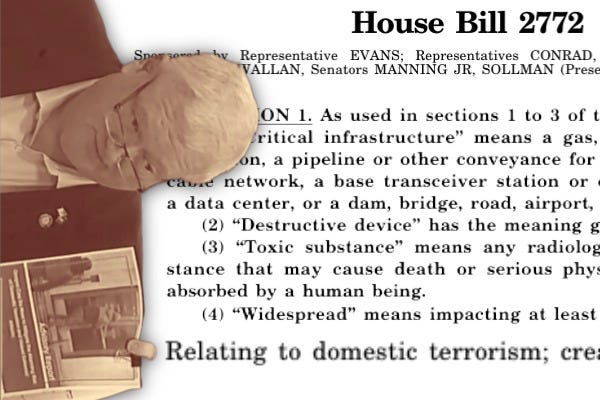
Rep. Paul Evans sat before Oregon’s House Judiciary Committee and told his fellow lawmakers that Oregon had a domestic terror problem.
“Oregon finds itself in the unique position of being very popular among people who decide sometimes in groups and sometimes to just by themselves to cause a little bit of havoc,” he said.
It was Feb. 8, 2023, and Evans, a longtime Democratic legislator from the small city of Monmouth, was there to discuss House Bill 2772, which would create a state law to curb domestic terrorism. (Evans did not return a request for comment for this story. He is currently seeking treatment after driving over a stop sign and registering a blood alcohol content of 0.16% during a traffic stop on Oct. 4, according to court documents and media reports.)
“It’s one of those situations where if you find a problem, and it’s a legitimate problem, you can either try to ignore it or you can recognize you have a duty to try to fix it,” Evans said.
He held up a printed copy of a 2022 report generated by auditors from former Secretary of State Shemia Fagan’s office, which determined that Oregon had the sixth highest domestic terror rate in the nation. “The findings are actually pretty clear,” Evans said.
As Evans’ bill made its way through the Legislature, the ACLU of Oregon issued a statement condemning the idea of a state domestic terror law, fearing it could be politically weaponized. “The ACLU of Oregon urges our state lawmakers to refuse to participate in creating and using tools like domestic terrorism laws that are unnecessary for accountability and are ripe for abuse,” the organization wrote in a statement in April 2023.
Nonetheless, that summer, the bill passed with little opposition and Kotek signed it into law.
What lawmakers failed to interrogate throughout that process was the data that the Secretary of State office’s report was built upon, despite Fagan’s own staff admitting that the report did not meet government auditing standards because it lacked detailed planning for fieldwork and typical quality controls. Still, the report assured, auditors spent time “checking evidence for each assertion in the report.”
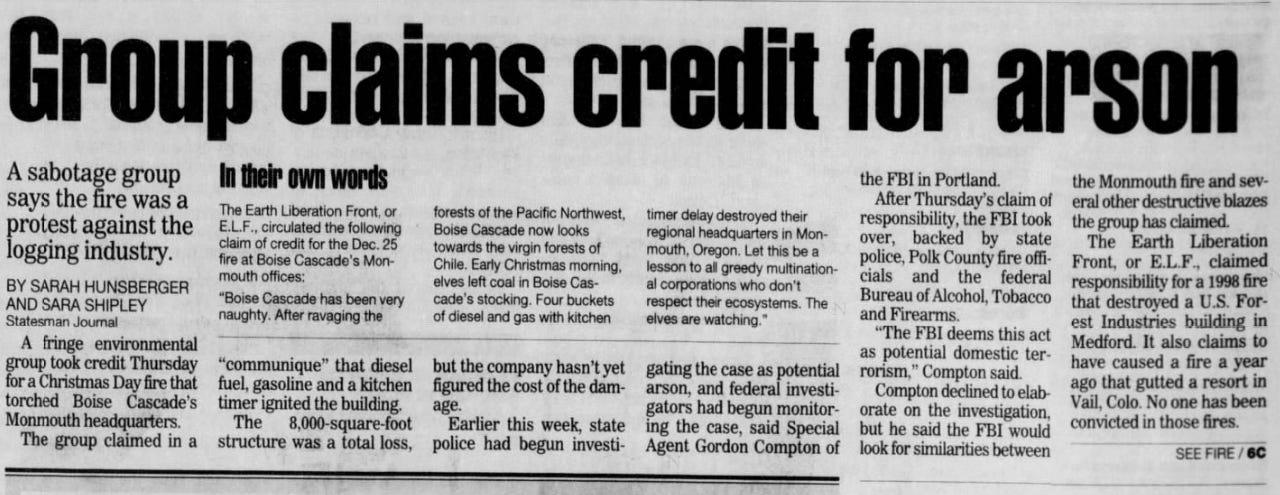
The idea that Oregon had the sixth-highest rate of domestic terror nationally relied on 51 incidents compiled by the Center for Strategic and International Studies (CSIS), a Washington, DC-based thinktank. CSIS arrived at Oregon’s rate largely based on arsons committed nearly 30 years prior by the Earth Liberation Front, a loose collective of environmentalists who served longer sentences in prison because prosecutors successfully argued for federal domestic terror enhancements in their cases.2
The Oregon ranking also hinged on a mishmash of incidents spanning a 30-year period, some of which resulted in no charges filed, dropped charges and times when arrests weren’t even made.3 4
CSIS declined a request for comment on this story, stating that the analysts who worked on the data have since left the organization.
Developing a domestic terror rate based on 30-year-old data struck some extremism experts as strange.
“Our collective understanding of terrorism has changed a few times since then,” said Amy Cooter, deputy director of the Institute for Countering Digital Extremism. She called the organization’s choice to include the Earth Liberation Front “questionable” considering the group has not existed since federal prosecutions took place in 2006.
The fact that Oregon based its law on CSIS data caused some experts on extremism deeper concern.
In 2025, CSIS researchers published a report titled “Left-Wing Terrorism and Political Violence in the United States.” Based on just five incidents, the report concluded that left-wing violence was on the rise. Cooter said that report was quickly cited by the Trump Administration as proof needed to prosecute left-wing activists.
Afterward, Cooter and PERIL’s Jensen wrote a critical response to the CSIS report. “The way the CSIS report was used highlights an essential responsibility for researchers in the current politicized era: maintaining methodological rigor and accurate interpretation of data to prevent the weaponization of findings for ideological and political ends,” the researchers wrote.
“It was very clear to me at the outset when reading that piece that it was primed to be misinterpreted and used in problematic ways,” Cooter told The Western Edge. “Since then, it’s been cited in multiple [ways] to claim that left-oriented people are the true threat when we’re talking about domestic terrorism.”
After the CSIS report on left-wing violence was published, Cooter said several attendees at a closed-door academic conference lambasted the report authors as irresponsible and accused them of doing shoddy work.
“It was the closest thing that happens in academia to a bloodbath,” she said.
While the second Trump Administration has issued an executive order designating antifa as a terrorist group, and has deployed the term “domestic terrorist” like a weapon, there is no agreed-upon federal definition of the term. It’s fluid depending on if the FBI or Homeland Security uses it.
The subjective and kaleidoscopic definition of domestic terrorism only becomes more complicated at the state level. Thirty-two states and the District of Columbia have their own versions of domestic terror laws, each varying slightly. In Arkansas, disabling “the usefulness or operation of a computer system used by any business or government unit” can be terrorism. In Illinois, “an act that causes substantial destruction to livestock or crops” is terrorism. Florida gives itself the power to designate entire groups as domestic terror organizations.
“We have seen now, in numerous cases, is [domestic terror laws are] being used in ways that they weren’t really intended,” Jensen, of PERIL, said.
Jensen and several other extremism experts interviewed by The Western Edge pointed to Georgia’s use of domestic terror statutes to prosecute Cop City protesters as a worst-case scenario. In 2023, prosecutors there charged dozens of people with domestic terror for protesting the construction of a $90 million law enforcement training center. (By late 2025, most of the charges had been dropped.)
When Rep. Paul Evans discussed his bill in front of the House Judiciary Committee, he said the focus of Oregon’s domestic terror law should be on infrastructure, not ideology — things like bridges, water supplies and power stations.
“It will send a clear signal for those who want to instill chaos, fear, terror, for its own sake, that there is an appropriate punishment, when proven guilty, when taking part in such things,” he said.
Beside Evans at a long wooden table facing the committee sat Rep. James Hieb, a Republican, and Aaron Knott, policy director for the Multnomah County District Attorney’s Office in Portland. The lawmakers brought Knott in to consult on the legal language of the bill.
Officials on the judiciary committee peppered Knott with hypotheticals. Rep. Lily Morgan, a Republican from Southern Oregon, brought up rumors she’d heard — ”whether they happened or not” — that police stations full of people would be padlocked, then attacked with molotov cocktails. Could that qualify as domestic terrorism under this bill? Knott said no. This was about intentional damage to take out infrastructure. (Knott declined a request for comment by The Western Edge.)
Rep. Charlie Conrad, a Republican from Springfield, asked about damage that occurred in the early 2000s to an SUV dealership in Eugene — incidents that were later tied to the Earth Liberation Front.5 No, Knott answered: the Oregon bill had to do with infrastructure, and intent was critical.
The last word was given to Hieb.
During August 2020 racial justice protests in Portland, Hieb was a part of a group of Young Republicans captured on video pepper-spraying anti-fascist demonstrators. Later, he said he had come to the protest to “film terrorists.”
“Domestic terrorism is happening and we need a mechanism of government to be able to prosecute these individuals so that we can all fall asleep at night.” — Former Oregon Rep. James Hieb (R-Canby)
He wanted Evans’ law to be used explicitly against people whose politics he opposed. “During 2020 and 2021, I witnessed many actions that I would consider to be domestic terrorism,” he said, referring to people who protested law enforcement following the murder of George Floyd and a subsequent federal crackdown.
“I saw these groups terrorize hundreds of Christian worshippers as they left a worship service at Waterfront Park,” he said. “This is terrorism. … Domestic terrorism is happening and we need a mechanism of government to be able to prosecute these individuals so that we can all fall asleep at night.” 6
Evans’ introduction of the bill came on the heels of a rash of media coverage about two incidents involving damage to Clackamas County electrical substations in November 2022.
Several Northwest media outlets reported that the FBI initially feared those attacks might have been the work of neo-Nazi groups.
It turned out they were not; federal prosecutors found the perpetrators — Nathaniel Cheney and Zachary Rosenthal — were petty criminals. One source familiar with Cheney and Rosenthal’s legal cases told The Western Edge on background that there was nothing “crafty, smart or really interesting about these cases.” 7
A representative from the Oregon U.S. Attorney’s Office confirmed to The Western Edge that domestic terrorism was never considered a factor in either man’s case.
And yet no media corrections were issued, and Oregon’s new law was soon solidified.
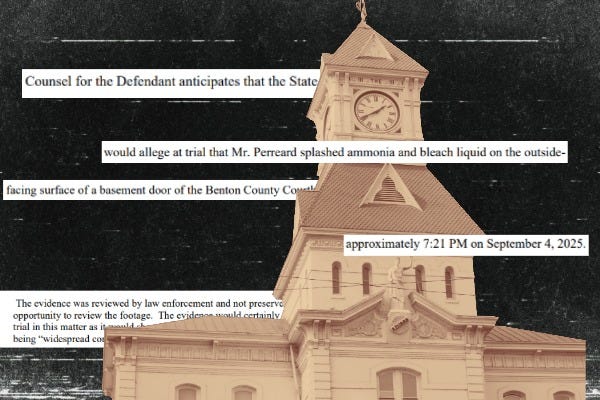
Darren Perreard was the first Oregonian to be charged with domestic terrorism.
By April 2025, Perreard had an extensive rap sheet of drug charges dating back to 1990, largely concerning methamphetamine. That spring and summer, he went on a tear through the Corvallis area: threatening staff at a local bakery, damaging a window, stealing a bike and violating a stalking order.
On Sept. 4 2025, he splashed bleach and ammonia on a side door of the Benton County Courthouse, in Corvallis. A Benton County deputy district attorney argued Perreard was trying to cause mass sickness and disrupt government services at the courthouse; the domestic terrorism charge soon followed. It turned out the courthouse had been empty except for one person, however, and the charges were soon dropped.
A 19-year-old named Rayden Coleman was the next person to be charged with domestic terror.
Coleman worked at a senior living facility in St Helens, Oregon, and in early 2026 was fired up about the activities of U.S. Immigration and Customs Enforcement, or ICE. Protests swelled around the country, and in Portland, where demonstrations outside the federal agency’s office had attracted the attention of Trump. The president threatened to send the National Guard to the building.
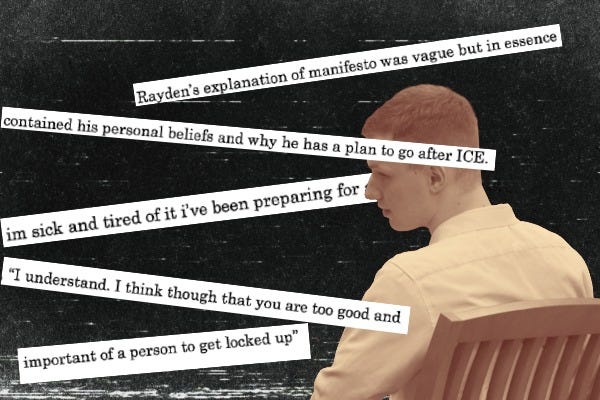
According to a sworn affidavit filed by police officers in the case, Coleman was upset over killings of Minneapolis residents Renee Good and Alex Pretti. His friends called local police after he talked about making molotov cocktails to throw at the ICE facility in Portland.
“Im sick and tired of it i’ve been preparing for while now. but i gotta get on it,” he texted a friend. “Im done just standing around im gonna get my hands on a firearm and will actively kill any ice agents see killing or kidnapping civilians.”
“I understand,” the friend texted back. “I think though that you are too good and important of a person to get locked up.”
In the affidavit, police officers said Coleman never actually made the molotov cocktails, but had acquired glass bottles, and had written a vague manifesto before putting money down on a rifle. (At the time of his arrest, he did not have possession of a gun.)
But, just like in Perreard’s case, the domestic terrorism charge was dismissed as the prosecution moved forward.
On Sept. 1, 2026, Coleman wore a neatly-pressed white shirt as he stood next to his attorney in court. Behind him, friends and family sat quietly, waiting for the judge to speak.
Coleman pleaded guilty to just two counts of unlawful manufacture of a destructive device, and was sentenced to three years of probation. The judge encouraged him to continue working on his mental health. (Coleman declined a request for an interview.)
But Columbia County District Attorney Joshua Pond — who declined a request for comment by The Western Edge — stood and said he wanted the record to reflect his dismay. 8
“The outcome of this case is somewhat frustrating to me,” Pond told the court. Though Coleman had been charged with the state’s new domestic terror charge, Pond made clear that this case was “a coordinated effort with us and federal law enforcement as well as federal prosecutors. Essentially, we were providing assistance for what was a federal investigation and likely a federal case.”
The small Columbia County DA’s office, Pond said, was left holding the bag.
“That federal case never materialized, and we found ourselves essentially attempting to address the matter at the state level,” he said. “The problem with doing so is that the state charges … are not something that have a lot of teeth to them.”
Though Oregon’s prosecutors have as yet failed to secure a single conviction under the state’s now three-year-old law, that may change soon.
In June, Ethan Noble Burlingame was charged with the state domestic terror law after lighting a series of fires over several days near the rural town of Fossil. One of the fires scorched a pair of Bonneville Power Administration poles — which are federal property. Electrical systems are listed as “critical infrastructure” in Oregon’s domestic terrorism law.
Burlingame’s attorney and Wheeler County District Attorney Gretchen Ladd did not return requests for comment. In September, a federal complaint showed Burlingame being additionally charged with two counts of arson affecting federal property.
Then, in early October, the 15-year-old Benson High School student in Portland was charged with domestic terror after his attempted chemical suicide. The charge represented yet another new front on how Oregon’s prosecutors plan to use the shakily-created law.
Media reports made much of the teenager’s potential affiliation with 764, but few explored the obscure online culture or its relevance to the alleged attack. According to a report by the Accelerationist Research Consortium (ARC), 764 is a depraved online space that draws in underage victims from apps like Discord and Telegram, then encourages those minors to commit horrific acts of abuse and self-harm. Online communities like 764 are of particular risk to kids who are “lonely, experiencing mental health crises, or lacking adult oversight,” according to ARC.
“764 is a brand. It’s kind of like Kleenex,” said Matthew Kriner, managing director of ARC. Kriner has appeared as an expert witness in court cases on 764 and what’s more broadly known to researchers as nihilistic violent extremism, or NVE. “In and of itself, it doesn’t really exist anymore.”
“A lot of times when people say, ‘Oh, he or she is tied into 764,’ what they’re really saying is that they’re tied into a digital ecosystem that is nihilistic violent extremism or the Com [Network] or sadistic online extortion.” 9
Kriner said that school attacks could be considered terrorism. “Terrorism doesn’t need to be ideological,” he said. “You can have a different reason for it, but if it terrorizes people, it’s still terror.”
Still, he was skeptical that using a state domestic terror law would curb school attacks. State laws can “open up new mechanisms to address types of crime that are not able to be dealt with in other criminal statutes already on the books,” he said.
But the NVE space is “heavily saturated” with young people who are both victimizing other people and victims themselves, Kriner added, making the label of terrorism much less clear. Until the Multnomah County DA’s office, or the FBI, says more about the Benson High student’s affiliations, it’s unclear how the teenager should be seen.
“Not having that deeper evidence puts us in a position where we’re having to trust that they’re charging a minor with a pretty hefty crime,” Kriner said. “The presumption here is that something he has done has been so dramatically outside of the range of other criminal charges that he needs to be labeled a terrorist and then treated as such at 15… that he cannot be reclaimed nor recovered to a point of being a contributing member of society.”
“I think that’s a really big thing to ask.”